How AI Is Transforming Supply Chain Visibility and Inventory Management
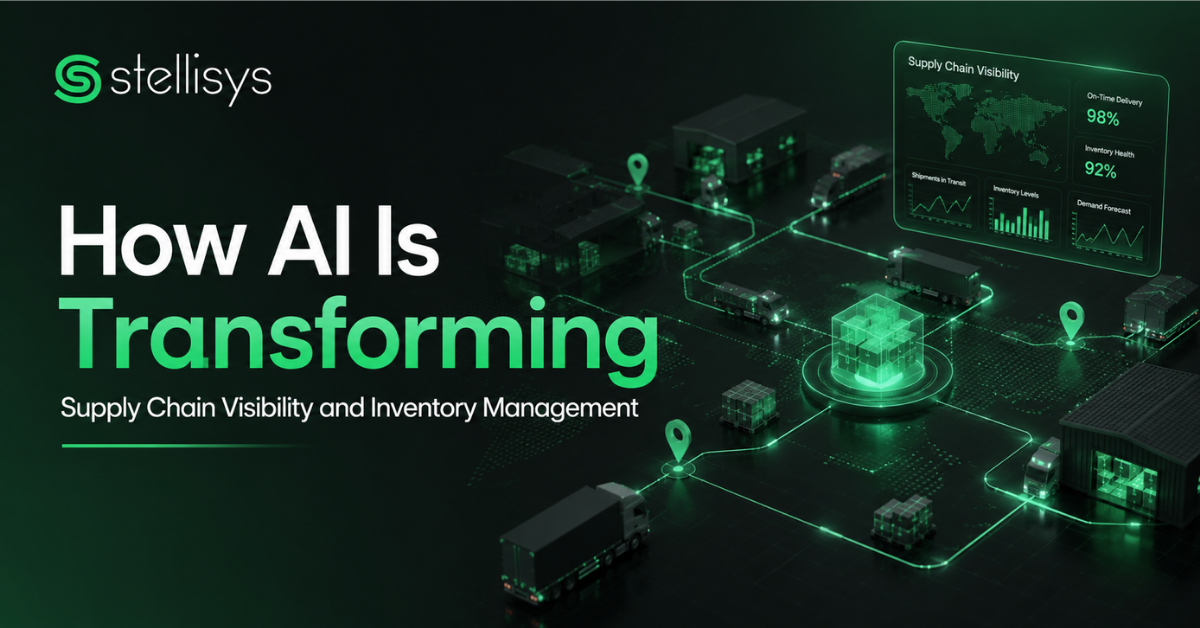
For a long time, supply chain visibility meant getting a report at the end of the week that told you what went wrong. A stockout you couldn't have predicted. An overstock sitting in a warehouse is eating into the margin. A supplier delay you found out about after it had already rippled through fulfillment. The information was there, just always too late to act on.
That's the problem AI is genuinely starting to solve.
In 2026, 87% of enterprises use AI for demand forecasting, driving a 35% improvement in accuracy, while 67% report a 28% drop in stockouts through AI-based inventory management. Those aren't marginal gains. For businesses running on thin margins across retail, FMCG, and distribution, that kind of improvement changes what's possible at the operational level.
Companies with AI-mature supply chains are 23% more profitable than their peers and six times as likely to use AI widely across their operations. The gap between early movers and everyone else is widening not gradually, but fast.
As Ann Marie Jonkman, VP of Global Industry Strategies at Blue Yonder, puts it:
"AI delivers meaningful productivity gains, accelerates decision-making, improves customer service, and reduces waste. But it's not a set-and-forget solution — strong leadership and governance are critical to achieve continued success."
— Ann Marie Jonkman, VP Global Industry Strategies, Blue Yonder
Source
That last part matters. Because the businesses seeing real returns from AI aren't the ones that plugged in a tool and hoped for the best. They're the ones that got their operational foundation right first clean data, connected systems, and a single source of truth that every department works from.
Research consistently shows that the vast majority of AI initiatives struggle to deliver sustained ROI due to fragmented data, siloed systems, and undocumented workflows, not immature AI tools. The technology isn't the bottleneck. The infrastructure underneath it is.
That's exactly where Stellisys comes in. It pulls inventory, sales, procurement, finance, and fulfillment into one place so when a stock level shifts, an order comes in, or a fulfillment update happens, every part of the business sees it at the same time. No chasing numbers across systems.
No waiting for someone to export a file. When the data is that connected, AI finally has something solid to actually work with. Visibility becomes genuinely real-time. Replenishment decisions happen faster. Problems surface before they become costly.
AI-enabled distribution operations see 5–20% logistics cost reduction, 20–30% inventory reduction, and 5–15% procurement spend reduction. But those results only show up when the systems feeding the AI are connected and trusted.
The transformation is real. It just starts one layer below the AI itself.