

The Future of ERP: Why Businesses Are Moving Toward Execution Systems
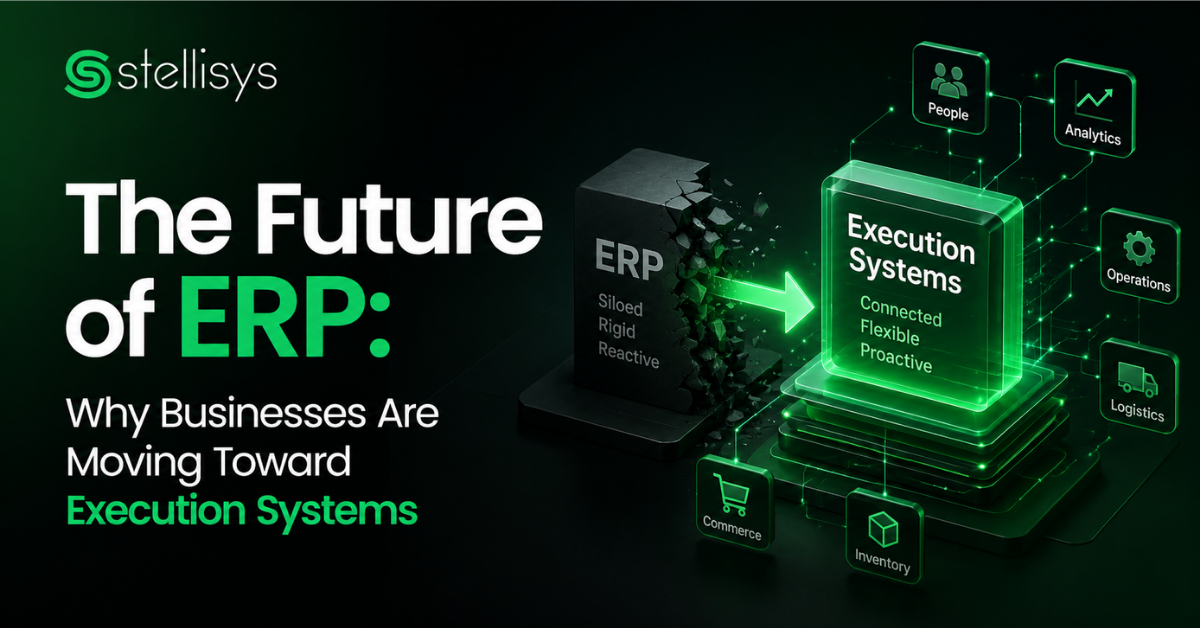
For a long time, ERP was sold as the answer to everything. One system to run finance, inventory, procurement, HR the whole business in one place. And in theory, that made sense. In practice, a lot of companies ended up with a system that recorded what happened without actually helping them do anything about it.
That's the gap businesses are waking up to right now.
The ERP market is approaching $106 billion in global spend in 2026. The investment is enormous. But the question companies are increasingly asking isn't "do we have an ERP?", it's "does our ERP actually help us execute?" There's a difference between a system that logs transactions and one that runs the business. Most traditional ERPs do the former. What's changing is the expectation that they should do the latter.
2026 marks the moment ERP shifts from transactional backend to a strategic intelligence layer. Treating ERP as static infrastructure is no longer viable to compete, systems must be real-time, modular, AI-ready, and built for execution, not just operational support.
As Kathy Quashie, EVP and CEO at Inetum Growing Markets, put it after delivering a full ERP implementation in 16 weeks:
"Operational innovation isn't about disruption — it's about building systems that work in the real world. Proof that disciplined execution and speed can go hand-in-hand."
— Kathy Quashie, EVP & CEO, Inetum Growing Markets
Source
Those framing matters. What growing businesses actually need isn't more configuration options or a longer feature list. What they actually need is a system that handles the transaction, keeps everyone working from the same numbers, and doesn't require someone to pull a report or fix a spreadsheet before a decision can be made.
Companies that have made that shift connected systems, live data, no manual patching are seeing 20% better forecasting accuracy and 15% lower operational costs. Not because the technology is complicated, but because the information is finally reliable enough to act on.
That's what Stellisys is designed to do. It runs inventory, sales, procurement, finance, and fulfillment on one connected spine not as separate modules that talk to each other occasionally, but as one system where every transaction updates the same record in real time. No lag. No reconciliation gap. No department is making decisions based on yesterday's numbers.
The future of ERP isn't a bigger, more complex platform. It's a system that quietly handles execution so well that the business stops thinking about it and starts focusing on what comes next.