

The Stellisys “Control Room”: Designing the Single Dashboard for E-commerce Founders
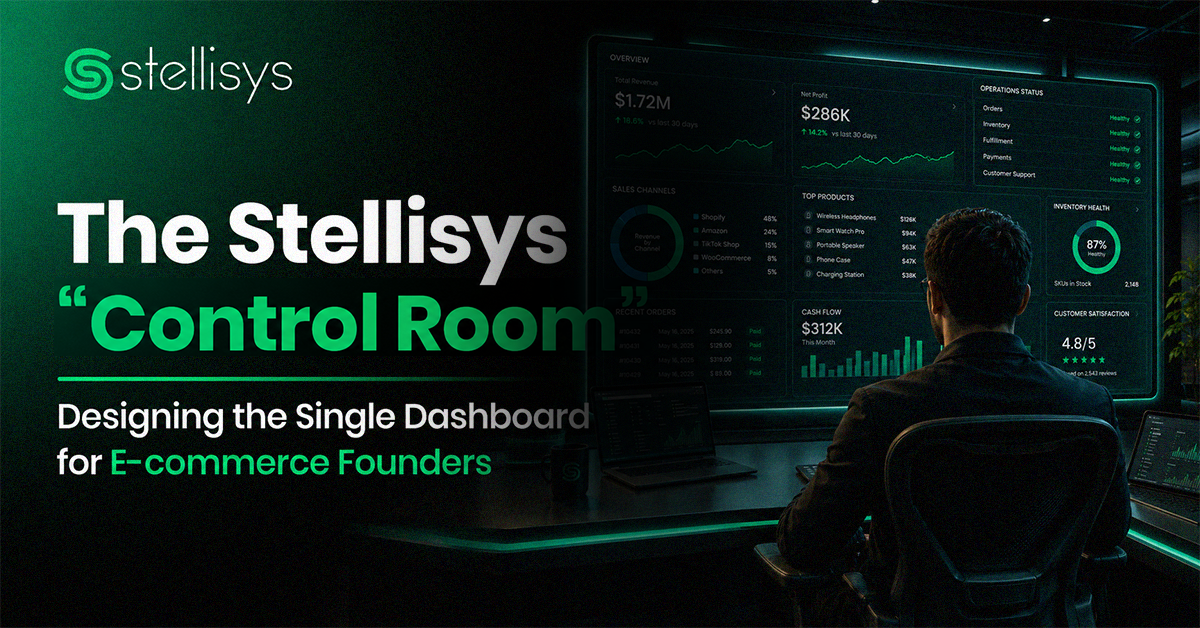
Being an e-commerce founder, you are in a world of data. There are sales dashboards, marketing reports, inventory tools, and finance sheets, each of which has its story to tell. The thing is that none of them narrates the entire story.
This is where the idea of a single operational “control room” becomes critical.
A true control room isn’t about seeing more numbers. It’s about seeing the right numbers, at the right time, in one place, so decisions don’t rely on gut instinct or delayed reports.
Most e-commerce teams struggle because their data lives in silos. Marketing sees growth. Finance sees margin pressure. Operations see stockouts. Each view is technically correct, yet leadership is left stitching insights together manually. By the time clarity emerges, the opportunity has often passed.
The Stellisys Control Room is designed to solve exactly this problem. It unites financial performance, inventory health, order fulfillment, and customer trends into one, decision-centered view. Founders receive a single source of operating truth, rather than jumping between tools.
What makes this approach powerful is intent. The dashboard is not constructed to look good; it is constructed to give directions.
This gap has been an issue that industry experts have been pointing to over the years. As one data strategy analysis puts it:
“Most dashboards are mirrors, not maps. They show what happened, but they rarely tell you what to do next and that’s the missing piece between data and decisions.”
— Hoick Blog, “Dashboards ≠ Decisions: Bridging the Last Mile of Insight”
https://blog.hoick.io/dashboards-%E2%89%A0-decisions/
That distinction matters. A report tells you what happened. A decision system tells you what to do next.
In a Stellisys control room, anomalies surface automatically. Inventory risks are flagged before stock runs out. Revenue trends are tied directly to operational constraints. Leaders do not ask, which number is right? and begin to ask, what shall we do today?
This clarity is a competitive edge for founders scaling rapidly. Delayed decisions increase costs silently, either in terms of stock buildup, lost demand, or emergency firefighting. When decisions are centralized and timely, teams move with confidence.
The future of e-commerce operations isn’t more dashboards. It’s one intelligent control room that turns complexity into clarity and data into direction.