

The Unified Commerce Revolution: Why Omnichannel Is No Longer Enough
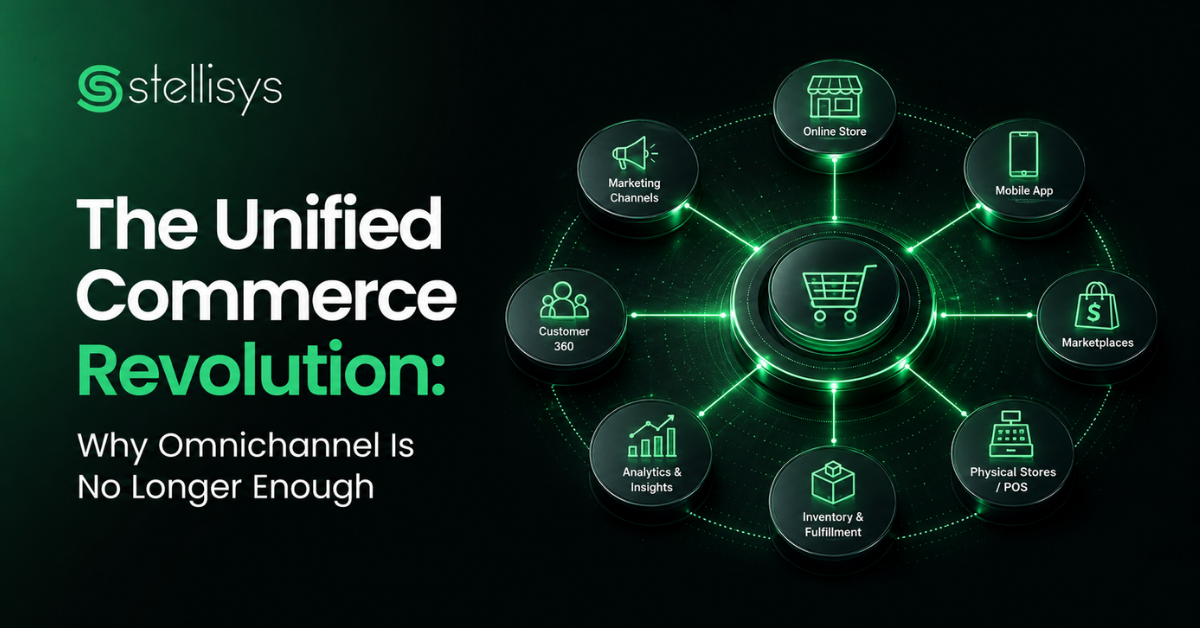
Omnichannel made a lot of sense when it came along. Get everywhere your customer is, keep things consistent across channels, and the sales will follow. And for a while, that thinking held up. But something shifted and the retailers still treating omnichannel as the destination are starting to feel it.
The issue was never the number of channels. It was what was happening behind them.
Most omnichannel setups connect the customer-facing experience the website, the app, the store without actually connecting the backend. Inventory updates in batches. POS data sits in one system. Finance lives somewhere else. A unified front end is displayed to the customer, while the back end is still working on fragmented information and manual reconciliation. That’s where margin leaks, fulfillment mistakes, and stockout surprises enter the equation.
According to the 2026 Unified Commerce Benchmark, 7% of retailers are in the true unified commerce leadership state, and 33% remain in the basic state. Leaders are transforming connected and data-driven experiences into close to 2x higher growth rates than their simple peers.
Retailers with unified commerce achieve 3x revenue growth, 1.7x increase in lifetime value of customers, and 31% decrease in fulfillment costs. Those numbers aren't the result of a better marketing campaign or a new channel launch. They're what happens when the backend finally works the way the frontend always promised it would.
As Katie Foote, SVP & CMO at Manhattan Associates, put it:
"Retailers pulling ahead are not doing it with one standout channel or a single capability. They are doing it by reimagining the entire customer journey and connecting the business end to end — from shopping and checkout to fulfillment and service."
— Katie Foote, SVP & CMO, Manhattan Associates
Source
That end-to-end connection is exactly what unified commerce demands and what most businesses still haven't built.
Unified commerce isn't just about adding more integrations to an already patchy tech stack. Every channel, every order, every stock movement goes through one system and everything updates at the same time. A customer buys in-store, and the online inventory adjusts instantly. A shipment arrives, and finance sees it without waiting for someone to run a report or send a file.
That's the foundation Stellisys is built on. One connected system across sales, inventory, procurement, fulfillment, and finance so every part of the business operates from the same live data, not a delayed version of it. No blind spots between channels. No reconciliation gaps at month's end. Just operations that actually reflect what's happening right now.
It's all channels, all transactions, all inventory movements, all in one system, all in real-time. When a customer purchases from the store, the stock information automatically updates online. Finance gets notified of the shipment when it arrives, without any files being exported.
The ambition is nearly universal. The execution gap is wide open.