

Why Month-End Closing Takes So Long in Growing Businesses (And How to Cut It in Half)
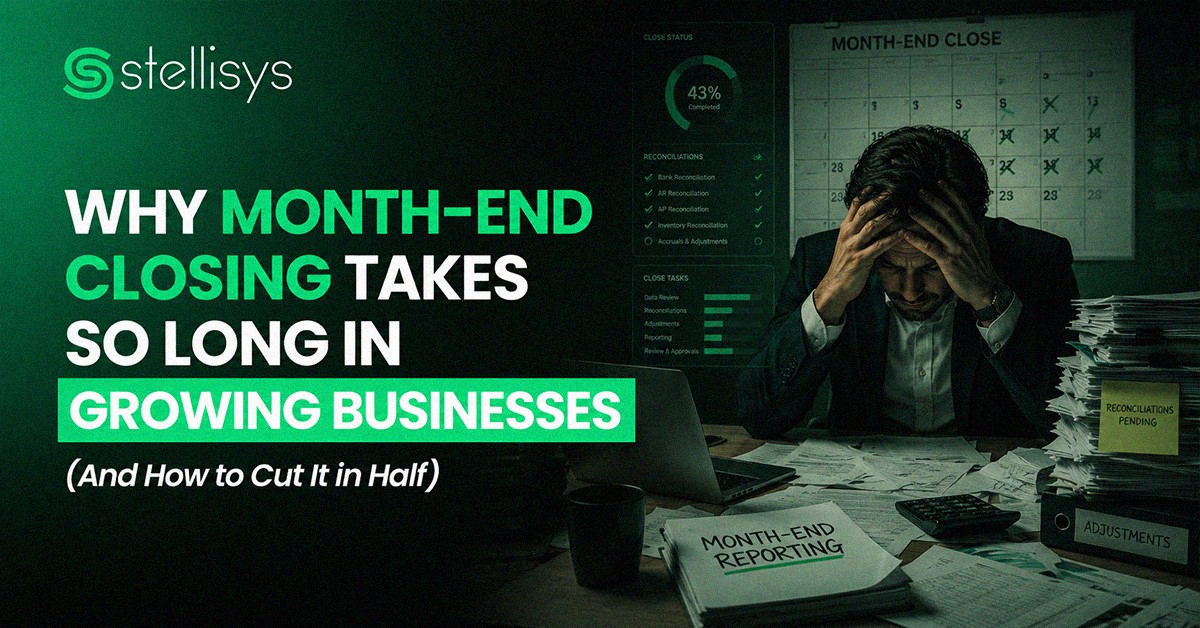
Month-end closing seems to be a bottleneck for most growing businesses. Finance departments operate on overtime, reports become tardy, and by the time the figures are finished, they are outdated.
The problem isn’t effort. Its structure.
On average, the month-end close takes 6–7 business days, but for smaller or fast-growing companies, it can stretch to 10–20 days or more. Even more concerning, 50% of finance teams still take over 6 days, while only a small percentage manage to close within 3 days. aiqlabs
And yet why does it take so long?
Fragmentation is the largest problem.
Most growing businesses operate across multiple systems: accounting software, POS, inventory tools, and spreadsheets. None of them syncs in real time. Finance teams are left manually reconciling transactions, chasing missing data, and validating numbers across platforms.
In fact, teams spend 20–50 hours every month just on reconciliations, often across disconnected systems. aiqlabs
This creates four major bottlenecks:
1. Delayed Data Collection
Finance waits on inputs from sales, operations, and external vendors.
2. Manual Reconciliation
Transactions across systems don’t match automatically, requiring time-consuming checks.
3. Lack of Real-Time Visibility
By the time the data is summed, it is no longer indicative of current business performance.
4. Dependency Chains
One delay in approvals or data blocks the entire closing process.
As Deloitte highlights:
“The biggest challenge… is turning data into actionable insights in real time.”
Source: https://www2.deloitte.com/us/en/insights/focus/industry-4-0/smart-factory-connected-manufacturing.html
Month-end closing isn’t just an accounting task, it’s an operational one. And without real-time systems, it becomes reactive by design.
The good news is that this can be rectified.
Leading companies are moving toward continuous closing models, supported by automation and integrated systems. Research shows that automation alone can reduce close time by 30–50%, bringing it down from weeks to just a few days.
This is where Stellisys plays a critical role. It avoids using disconnected tools, instead developing a single operation layer that integrates financial information, inventory, and transactions in real-time.
Reconcilments become automated, dependency is minimized, and the finance teams are able to work on insights rather than on manual work.
Because the goal isn’t just to close the books faster.
It’s to make decisions while the numbers still matter.